Showing posts with label rearfacing. Show all posts

Saturday, December 11, 2010

Happy Birthday!

Time to turn the car seat around, right?  Actually, it's best to hold off. In fact, the American Academy of Pediatrics released a new recommendation in March 2011 stating "Toddlers should remain rear-facing in a convertible car seat until they have reached the maximum height and weight recommended for the model, or at least the age of 2." And here's why:

Rear-facing is the safest way your child can ride.  In a crash, a rear-facing car seat will support the child's head, neck and spine, preventing injury.  In contrast, if the child is forward-facing, the child's upper body is restrained by the car seat's harness, but the energy of the crash is transfered to the child's head and neck, causing whiplash.  In an adult, whiplash is merely painful, but in a child, it can be deadly.  As we know, a child's head is much larger in proportion to the body than an adult's, and the child's vertebrae are still immature (the vertebrae do not become fully ossified--or hardened--until between 4 and six years of age).  Any amount of stretching of the spinal cord can be catastrophic for a young child--it can cause paralysis or death.

Here are some visuals on crash testing:
Here is a forward-facing child restraint:

And here is what happens if the child is rear-facing: 

Here is the story of Joel

Visit Joel's website for more information

Still have doubts?  Let's visit some frequently asked questions...

"But where do their legs go? Aren't they uncomfortable all squished up like that?  Wouldn't their legs get broken in a crash?"

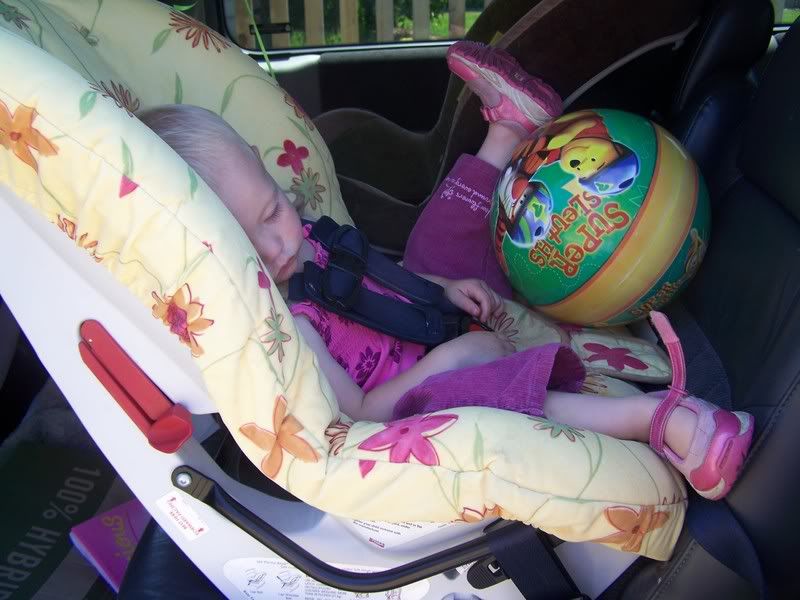
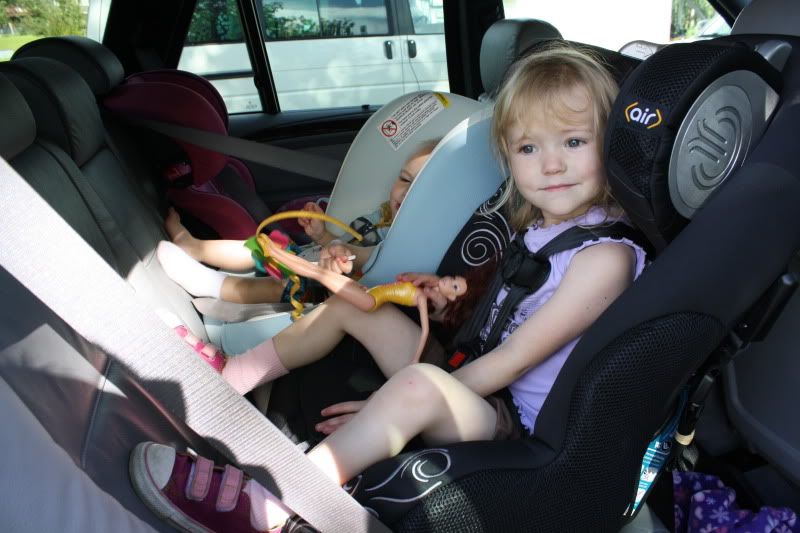
As parents, we all worry about our children's comfort.  However, watch a young child as they sit on the floor.  Where are their legs?  Usually they are folded underneath, or out to the side, or "criss-cross applesauce".  Same is true in the car--as the child grows, so do their legs, and they either cross them in the seat, prop them up against the seat back, fold them or swing them over the side of the seat.  

As far as leg injuries go, they are very rare with a rear-facing child--there are actually more reports of injuries to forward-facing kids' legs!  


 "What if I am rear-ended?"

This is a good question.  However, statistically rear-end or rear-offset crashes are not nearly as common as frontal or frontal-offset impacts.  Here's a handy little picture that shows the exact numbers:
In addition to being less common than frontal-impact crashes, rear-impact crashes are usually at much lower rates of speed--generally, the rear-ended car is stopped or moving at a slow rate of speed, and the driver of the impacting car is usually braking.  

"I never had a car seat when I was a kid, and I turned out okay!"

This is a very common argument; however, it's a flawed one.  According to the Insurance Institute for Highway Safety (IIHS), the fatality rate for children under the age of 13 has declined from 79.5 per million in 1975 to 19.8 per million in 2009.  

Make sure to check out these sites for more information about extended rear facing!

Monday, November 29, 2010

Baby's First Ride

As new parents, you will find that the ride home from the hospital is one of the scariest events in your life.  You  have this new precious little life you are responsible for, and you are suddenly very aware of all the other cars speeding past you.  Make sure you transport your precious cargo safely!  


Here's a few general rules for properly buckling up baby:
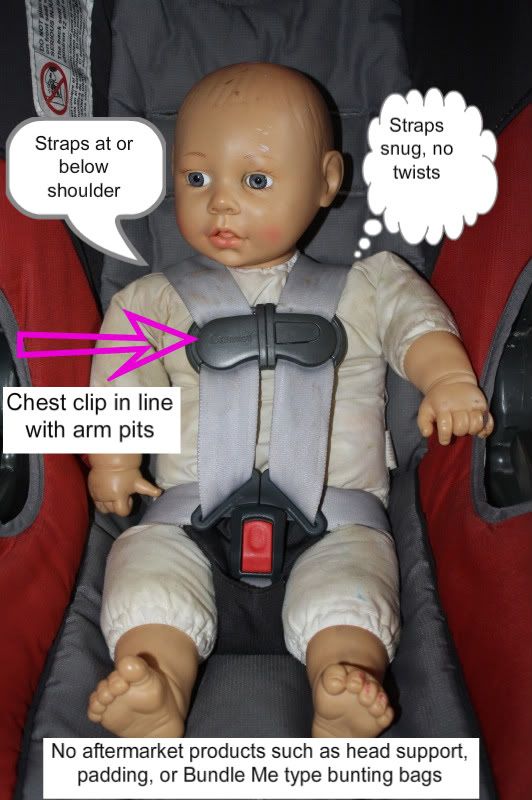
#1: Make sure that the harness lies flat on baby, with no twists in the straps.


#2: For a rear-facing child, the straps need to be at or below the child's shoulder.


#3: Tighten up those straps!  It can be pretty daunting tightening up the straps on a brand-new baby, but keep in mind that if the car were to suddenly be upside down, those straps need to hold baby safely in the seat, and in order to do that, they need to be tight.  Make sure you pull all the slack from around the baby's thighs, and pull the harness adjuster gently to tighten.  The straps need to pass the "pinch test": try to pinch a horizontal fold in the strap where it crosses the baby's collarbone.  Your fingers should just slip off; if you can pinch any fold, you need to snug up the harness some more.


#4: Position the chest clip properly.  The chest clip needs to lie...well, on the baby's chest! ;)  The perfect spot is with the top of the chest clip right in line with baby's armpits.  The sternum is the strongest point on the infant's torso, and having the chest clip low on the belly can cause damage to abdominal organs in a crash.


#5:  Make sure the infant seat is at the correct angle.  Newborns have no head or neck control, and it's imperative that their car seats are reclined at the proper 45* angle.  If the infant seat is too upright, it can cause the baby's head to flop forward, with the baby's chin on her chest, cutting off the airway.  


#6. Use only what came in the box with the car seat--no aftermarket products.  Those super-fluffy infant positioners, strap covers, head positioners and 'bundle bags' are all tempting, but they are not considered safe for use with car seats.  The general rule is nothing between the car seat and the baby, or the baby and the straps.  Any additional bulk will compress in a crash, introducing slack into the harness and putting the baby at risk to be ejected from the seat.  


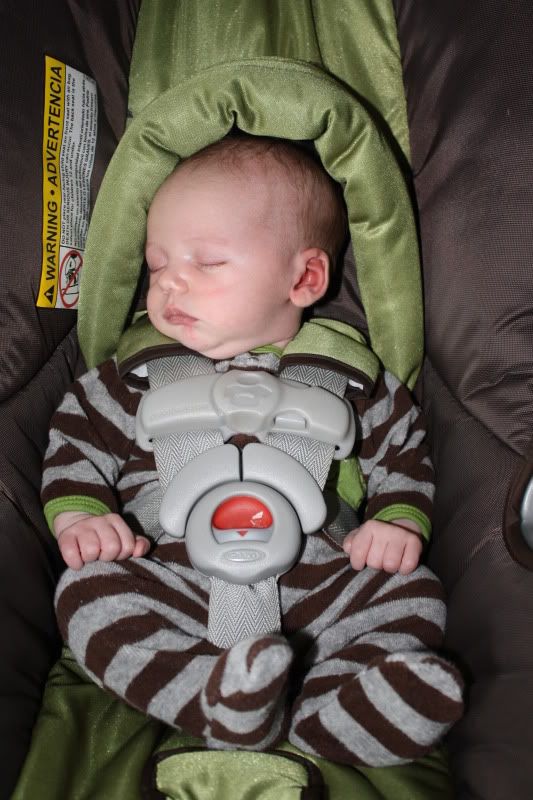
Here is my third baby, correctly buckled and ready to go!